Interstellar Visitors: What We Learn from Objects From Beyond Our Solar System
A concise guide to interstellar objects — from 'Oumuamua and 2I/Borisov to recent candidates — why they matter and how we can study them.

- Dr. Vivek Shilimkar
- 3 min read
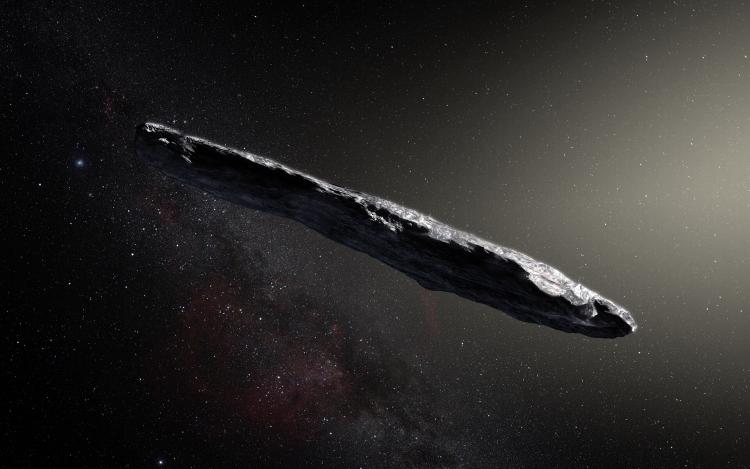
Interstellar objects — bodies that originate outside our Solar System and pass through it — have captured astronomers’ imaginations since 2017, when the first confirmed visitor, 1I/‘Oumuamua, was discovered. These rare wanderers are natural laboratories: they carry material formed around other stars and let us test ideas about planet formation, the distribution of volatiles, and even the possibility of panspermia.
1. A brief history: ‘Oumuamua and 2I/Borisov
-
1I/‘Oumuamua (2017): Detected by the Pan-STARRS survey, ‘Oumuamua surprised scientists with its unusual shape, accelerated motion inconsistent with gravity alone, and lack of visible coma typically associated with comets. Debate swirled over whether it was a fragment of a disrupted planetesimal, an icy body losing mass via outgassing, or (less likely) an artificial object.
-
2I/Borisov (2019): The second confirmed interstellar object, a clear comet with a visible coma and composition similar yet distinct from Solar System comets. Borisov confirmed that interstellar objects come in more than one flavor: dusty/volatile-rich comets as well as possibly rocky fragments.
2. How we detect them
- Wide-field survey telescopes (Pan-STARRS, ZTF, ATLAS) scan the sky nightly, comparing images to detect moving objects.
- Rapid follow-up with ground-based spectroscopy and imaging determines whether an object is bound to the Sun or on an escape trajectory (hyperbolic orbit).
- Improved detection pipelines and AI-based classifiers are increasing detection rates and helping flag high-priority interstellar candidates quickly.
3. Why they matter
- Exoplanetary material samples: These objects carry the chemical fingerprints of other planetary systems — ices, dust, and refractory materials — enabling comparative planetology without leaving Earth.
- Planet formation constraints: The distribution, composition, and abundance of interstellar objects inform models of planetesimal formation and ejection during planet formation.
- Origins of life research: If interstellar objects carry complex organics or even microbial life (controversial), they could inform panspermia hypotheses.
4. Recent candidates and ongoing searches (2024–2025)
Survey pipelines have matured since 2017. Teams now identify hyperbolic candidates earlier, and follow-ups are faster. Notable developments include:
- Improved automated filters that reduce false positives and flag candidates for spectroscopy within hours.
- Reports of several hyperbolic meteors and small bodies whose detailed orbital solutions are still being examined to confirm interstellar origin.
- Dedicated software communities analyzing archival data to search for missed interstellar visitors.
5. Challenges and uncertainties
- Short observation windows: Interstellar objects travel very fast through the inner Solar System, leaving little time for observations.
- Faintness: Many are small or non-active and thus hard to detect until they are very close to the Sun.
- Orbit determination sensitivity: Non-gravitational forces (outgassing) and measurement errors can complicate determining whether an orbit is truly unbound.
6. Science and mission opportunities
- Rapid-response intercept missions: Concepts like ESA’s Comet Interceptor or proposed rapid missions to intercept interstellar objects aim to get in-situ measurements.
- Sample-return proposals: Ambitious but scientifically valuable — returning material from an interstellar body would revolutionize planetary science.
- Meteor network integration: Coordinated meteor camera networks and infrasound arrays can catch interstellar meteors and recover fragments.
7. What to watch for next
- New wide-field telescopes coming online (Vera Rubin Observatory/LSST) will dramatically increase sensitivity to faint, fast-moving objects.
- Improved machine-learning classifiers that flag interstellar candidates within hours of detection.
- International coordination for rapid spectroscopic follow-up and possible mission concepts focused on fast interception.
8. Conclusion: Small visitors, big science
Interstellar objects are cosmic postcards. They arrive unexpectedly, but each one carries vital information about the materials and processes that shaped other planetary systems. With better surveys, faster follow-up, and international coordination, the coming decade promises a steady trickle — and perhaps a flood — of these remarkable messengers from beyond.